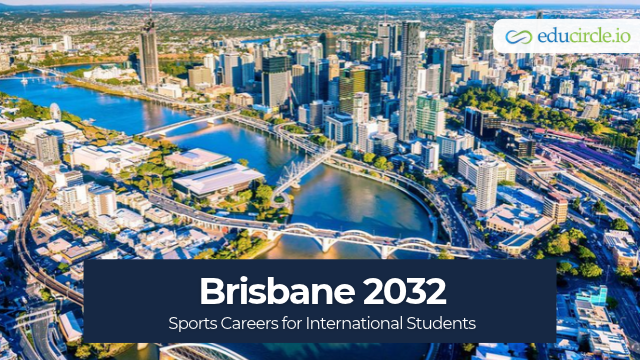
“I’m Interested in Sport”: Careers Being Built Around Brisbane 2032
Brisbane 2032 is creating opportunities far beyond athletes and coaches. From physiotherapy and sports analytics to event management, marketing, infrastructure and venue operations, students can build careers connected to one of Australia’s biggest upcoming global events.
When students say they want a career in sport, the conversation often goes straight to sports science, coaching or professional athletics.
But the sports industry is much bigger than what happens on the field.
Australia is preparing to host the Brisbane 2032 Olympic and Paralympic Games, and the event is creating demand across a wide professional ecosystem. Healthcare professionals will support athletes and rehabilitation. Data specialists will analyse performance and audiences. Marketing teams will manage sponsors and partnerships. Event professionals will operate venues. Engineers, construction managers and project specialists will help deliver the infrastructure needed for the Games.
For an international student starting university in 2027, the timing is particularly interesting. A typical three-year bachelor's degree could finish around 2029–30, leaving several years to gain Australian work experience before and during the Games.
The opportunity is not guaranteed. But unlike many career trends, Brisbane 2032 provides students with a clearly defined event, a published timeline and a growing ecosystem to plan around.
The Brisbane 2032 Timeline Matters
The Brisbane 2032 Organising Committee is already building its workforce, with roles spanning areas such as athlete experience, accommodation, procurement, village operations, legal services and marketing partnerships.
Government and infrastructure projects connected to the Games are also creating opportunities across project management, engineering, construction, finance, governance and technology.
The construction and infrastructure pipeline is expected to develop in stages through the late 2020s, creating additional demand as venues, transport infrastructure and other Olympic-related projects move forward.
This creates an important distinction for students:
You do not necessarily need to study “sports” to build a career in the sports industry.
A student studying physiotherapy, business analytics, marketing, engineering, construction management or project management may eventually work on a sports-related project without having a traditional sports degree.
The Careers Behind Brisbane 2032
| Career | Relevant Qualification | Potential Workplace | Indicative Pay (AUD) |
|---|---|---|---|
| Sports Physiotherapist | Bachelor/Master of Physiotherapy + registration | Clinics, rehabilitation, elite teams | $70,000–$110,000+ |
| Sports Scientist / Exercise Physiologist | Exercise & Sport Science + relevant accreditation | High-performance sport, healthcare, community health | $65,000–$95,000 |
| Sports Analyst | Sports Science, Data Analytics or Business Analytics | Teams, leagues, broadcasters, data companies | $75,000–$120,000 |
| Event & Venue Manager | Event Management or Sport Management | Stadiums, councils, event organisations | $75,000–$100,000+ |
| Sports Marketing & Partnerships | Marketing, Business or Communications | Organising committees, sponsors, agencies | $65,000–$110,000 |
| Infrastructure / Project Professional | Engineering, Construction or Project Management | Venues, transport, Olympic infrastructure | $120,000–$190,000+ for senior/project roles |
Salary ranges are indicative and vary by experience, location, employer and role. Professional registration or accreditation may be required for regulated occupations.
1. Physiotherapy: A Career With Sport and Healthcare Options
For students who want a direct connection to sport while also building a broader healthcare career, physiotherapy offers one of the clearest pathways.
Physiotherapists can work with athletes on injury prevention, rehabilitation and recovery. But the career does not depend entirely on elite sport.
Graduates can also work in hospitals, private clinics, rehabilitation centres, aged care and community healthcare.
That matters because professional sports positions are relatively limited. A physiotherapy qualification gives students the option to pursue sports while maintaining access to a much wider healthcare employment market.
Students should also understand that physiotherapy is a regulated profession in Australia, meaning overseas-trained or Australian-qualified practitioners must meet the relevant registration requirements.
For students interested in Brisbane and South East Queensland, universities such as the University of Queensland, Griffith University and QUT provide opportunities to study within a region that will remain closely connected to the Games.
2. Sports Science: Performance Meets Healthcare
Sports science is another obvious pathway, but students should understand what the degree can actually lead to.
Exercise and sports science graduates can work across high-performance sport, exercise rehabilitation, health promotion, community health and fitness.
The more valuable opportunity may come from combining sports knowledge with another technical skill.
For example:
Sports Science + Data Analytics
can lead toward performance analysis, athlete monitoring and sports technology.
Similarly:
Sports Science + Business
can open pathways into sports management, operations and commercial roles.
This is increasingly important because modern sport is becoming a data-driven industry. Teams and organisations collect information about athlete performance, training loads, audience behaviour, ticketing, media and commercial activity.
The ability to understand both sport and data can therefore create opportunities beyond traditional sports science roles.
3. Sports Analytics: Where Data Meets Sport
You do not have to be an elite athlete to build a career in modern sport.
Sports analytics combines statistics, data science and sporting knowledge to help organisations make decisions.
Depending on the role, analysts may work with:
Player and team performance data
Match statistics
Audience behaviour
Ticketing and attendance
Sponsorship performance
Broadcast and streaming data
Recruitment and scouting information
Training and injury data
Students with strong mathematics, statistics or programming skills may therefore consider degrees in data analytics, business analytics, computer science or sports science with analytics components.
The advantage of this pathway is portability. Data skills can be used in sport, technology, finance, consulting, media and other industries if a student does not immediately secure a sports-related position.
4. Event and Venue Management
The Olympic Games are, at their core, one of the world's largest event-management operations.
Thousands of people are involved in making venues function, coordinating spectators, managing logistics, supporting athletes and delivering events.
That creates opportunities for graduates in:
Event management
Sport management
Hospitality
Operations
Project management
Communications
Customer experience
Venue management
South East Queensland is particularly relevant because Brisbane and the Gold Coast already have significant event and sporting infrastructure.
For students pursuing this route, practical experience can be as important as the degree itself.
Volunteering at sporting events, working part-time at venues and gaining experience in event operations can help students build a portfolio before graduation.
5. Sports Marketing and Partnerships
Sport is also a major commercial industry.
Behind every major event are teams working on sponsorships, partnerships, advertising, social media, public relations, content, ticketing and audience engagement.
A marketing student does not necessarily need a sports degree to enter this part of the industry.
A background in:
Marketing + Sport
or
Business + Digital Marketing
can provide a pathway into sports organisations, agencies, sponsors and event companies.
The Brisbane 2032 ecosystem could therefore be relevant to students who are more interested in branding and communication than athlete performance.
For students already developing skills in social media, content creation, paid advertising, analytics or partnerships, sport can become a specialist industry rather than a completely separate career path.
6. Infrastructure: The Careers Most Students May Overlook
Some of the biggest opportunities connected to the Games may not have the word “sport” in the job title at all.
The delivery of major sporting events requires infrastructure.
That means opportunities for:
Civil engineers
Structural engineers
Construction managers
Project managers
Quantity surveyors
Architects
Transport specialists
Procurement professionals
Sustainability specialists
Technology professionals
These professionals can work on venues, transport, accommodation, public infrastructure and other projects supporting the Games.
For a student who enjoys sport but also likes engineering, construction or project delivery, this may be one of the most practical ways to connect the two interests.
The Six-Year Career Window
The timing is one of the most interesting parts of Brisbane 2032.
A student beginning a three-year bachelor's degree in 2027 could graduate around 2029 or 2030.
That potentially leaves time to:
2027–2029
Study, build skills and gain internships or part-time experience.
2029–2030
Graduate and enter the Australian workforce.
2030–2032
Build relevant professional experience as the Games approach.
2032
Potentially work within the broader Brisbane 2032 ecosystem, depending on qualifications, experience and available positions.
This is not a guarantee of employment. Competition will remain high, particularly for roles directly inside the Organising Committee.
But the timeline gives students something valuable: a target around which they can plan their education and experience.
The Important Reality: Don't Study Only for the Olympics
The biggest mistake would be choosing a degree simply because it appears connected to Brisbane 2032.
The Games last for a limited period.
Your career needs to last much longer.
A stronger strategy is to choose a qualification that has value beyond the event and then use Brisbane's sporting ecosystem as an additional career opportunity.
For example:
Physiotherapy → healthcare + rehabilitation + sport
Data Analytics → technology + business + sport
Engineering → infrastructure + construction + major events
Marketing → corporate + agencies + sports partnerships
Project Management → infrastructure + events + commercial projects
Event Management → venues + hospitality + festivals + major sporting events
This creates a more resilient career plan.
Sport Is an Industry, Not Just a Profession
The sports industry needs far more than athletes.
It needs doctors and physiotherapists.
It needs analysts and data scientists.
It needs engineers and construction managers.
It needs marketers, lawyers and procurement specialists.
It needs event managers, venue operators and technology professionals.
It needs people who can manage budgets, audiences, infrastructure and partnerships.
That is why Brisbane 2032 is worth watching for students who are interested in sport.
The opportunity is not simply “work at the Olympics.”
The bigger opportunity is to build a professional skill that has value in the wider economy and then use Australia's growing sports ecosystem as one of the places where that skill can be applied.
For a student starting in Australia in 2027, Brisbane 2032 could become more than a sporting event on the calendar.
It could become a career milestone to plan toward.