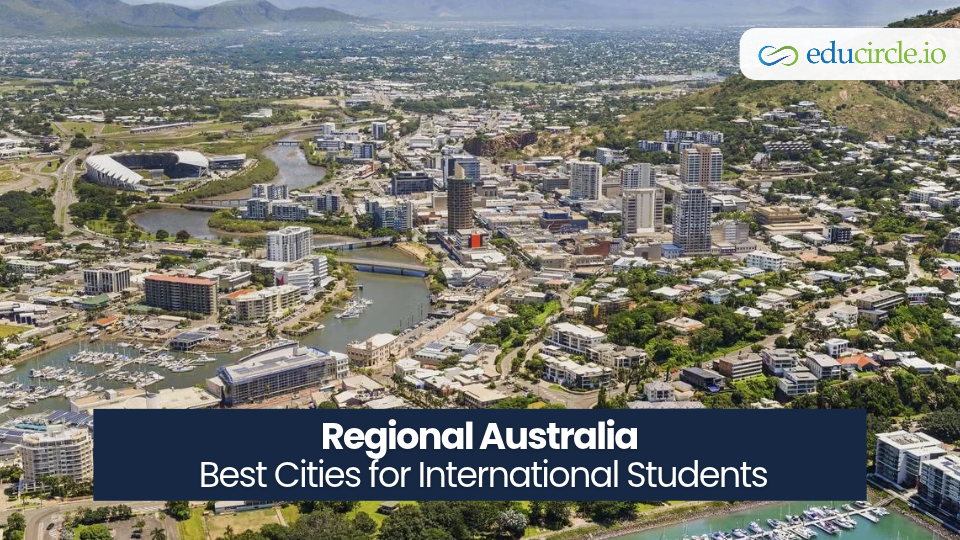
‘Regional’ Australia is not synonymous with remote. For international students, cities such as Adelaide, Perth, Canberra, Newcastle and Wollongong can offer a compelling combination of universities, career opportunities, lower living costs and a different quality of life from Sydney or Melbourne.
There is a common assumption among Indian students that choosing a regional destination means moving to a small town with limited services, few career opportunities and little international community. That assumption can eliminate some of Australia’s most practical study destinations before students even consider them.
Australia’s regional classification includes established cities such as Adelaide, Perth, Canberra, Newcastle, Wollongong, Hobart, the Gold Coast and Darwin. These are places with major universities, hospitals, airports, professional industries, cultural communities and growing employment markets.
Rather than looking at regional Australia only through the lens of migration pathways, it is worth considering these cities on their own merits.
Wollongong: A University City by the Coast
Located around 80 minutes south of Sydney, Wollongong combines a strong university environment with beaches, outdoor lifestyle and access to Sydney.
The city sits between the Pacific Ocean and the Illawarra escarpment, with numerous beaches across the local area. For students, that means a lifestyle that can be difficult to replicate in Sydney without paying a significant premium.
The University of Wollongong (UOW) is particularly relevant for students interested in technology and cybersecurity. Its Cyber Academy, developed with TAFE NSW and industry partners, is designed to create practical pathways into cybersecurity careers through an earn-as-you-learn model.
For a student considering cybersecurity while looking for a lower-cost alternative to Sydney, Wollongong deserves serious consideration.
Newcastle: Where the Energy Transition Is Happening
Around two hours north of Sydney, Newcastle has evolved from its industrial and port heritage into a city increasingly connected to clean energy, advanced manufacturing and technology.
Construction remains one of the city's largest economic sectors, while the broader Hunter region is becoming an important part of Australia's energy transition.
The Hunter Valley Hydrogen Hub, supported by significant ARENA funding, is developing large-scale renewable hydrogen production. The University of Newcastle also has strong capabilities in engineering, automation and related disciplines.
This creates an interesting proposition for students studying engineering, environmental science, renewable energy or related fields: the industries they are learning about are actively developing in the surrounding region.
A smaller city does not automatically mean fewer opportunities. In the right discipline, proximity to industry can become an advantage.
Adelaide: The Value Proposition
Adelaide is one of the strongest examples of why students should rethink what “regional” means.
It is a substantial capital city with universities, hospitals, professional services, cultural institutions and a growing technology and advanced-manufacturing ecosystem. At the same time, living costs can be more manageable than in Sydney.
Shared accommodation can often fall in the range of approximately AUD $180–$300 per week, while overall living expenses can be significantly lower than Australia's most expensive major cities.
Adelaide also offers a compact city centre, extensive public transport and easy access to destinations such as the Adelaide Hills, Barossa Valley and McLaren Vale.
From a career perspective, South Australia has strategic interests in defence, space, technology, healthcare and advanced manufacturing. The Australian Space Agency is headquartered in Adelaide, while the state continues to identify occupations across areas including nursing, software engineering, civil engineering, teaching, social work and construction.
For students who want a major-city infrastructure without Sydney-level living costs, Adelaide is one of the strongest options to investigate.
Hobart: Small City, Exceptional Research
Hobart is smaller than the other cities featured here, but its academic and environmental identity is unusually strong.
The University of Tasmania has internationally recognised strengths in marine, environmental and Antarctic-related research. Hobart also plays an important role as a gateway for Australia's Antarctic and Southern Ocean activities.
That makes the city particularly interesting for students interested in marine science, environmental science, climate research or Antarctic studies.
Outside academia, Hobart has developed a distinctive cultural and food identity. MONA has transformed the city's international cultural profile, while Tasmania's natural environment provides easy access to mountains, coastline and wilderness.
For the right student, Hobart should not be viewed as a fallback destination. Its specialised research ecosystem can make it a highly targeted choice.
Canberra: Government, Policy and Cybersecurity
Australia's capital city is another example of a “regional” destination that looks very different from the stereotype.
Canberra is a planned, relatively compact city with a high concentration of government departments, policy organisations, research institutions and technology companies.
It is also an important cybersecurity centre, with the Australian Signals Directorate headquartered in the city and a large ecosystem of government contractors and technology businesses.
The Australian National University (ANU) is one of the country's leading universities, while the University of Canberra has strengths across areas including governance, design, health and sport.
There is, however, an important limitation for international students: many Australian government positions require Australian citizenship. Students should therefore distinguish between direct government employment and opportunities within the private sector, consulting firms, technology companies and the broader government supply chain.
Canberra can be an excellent destination for students interested in policy, cybersecurity, technology and related fields — provided they understand the employment landscape before choosing their course.
The Real Advantage: Cost, Lifestyle and Access
The regional-city argument should not depend entirely on migration incentives.
For many students, the immediate advantage is simpler: how much does it cost to live there, and what kind of life can you build while studying?
The difference in living expenses between Sydney and a city such as Adelaide can become substantial over a two-year degree. Saving even several thousand dollars a year can reduce financial pressure on students and their families.
Then there are the less obvious advantages:
- Shorter daily commutes
- Potentially lower accommodation costs
- Easier access to university facilities
- Stronger connections with local employers
- Less intense competition for some specialised roles
- Better access to beaches, parks and outdoor spaces
- Established international and migrant communities
But regional cities are not automatically better.
The Trade-Off You Need to Understand
The job market in a regional city is usually smaller and more concentrated than in Sydney or Melbourne.
That can work in your favour if your degree matches the local economy.
A student studying health in Adelaide, clean energy in Newcastle, cybersecurity in Wollongong or Canberra, or marine science in Hobart may find the local industry ecosystem highly relevant.
But if your intended career is heavily concentrated in Sydney or Melbourne, moving to a smaller city could reduce the number of immediately available opportunities.
The right question is therefore not:
“Is regional Australia better than Sydney?”
It is:
“Does this city's economy match the career I want to build?”
That is the research students should do before choosing a university.
Look at the major employers, priority industries, internship opportunities, graduate vacancies and professional networks in the city where you plan to study. Compare those factors with your specific degree and career goals.
Regional Australia is not one destination or one experience. It is a collection of very different cities — and for the right student, one of them could offer a better combination of education, career opportunity, affordability and lifestyle than a traditional choice of Sydney or Melbourne.
Sources: Newcastle Economic Profile 2023/24; ARENA Hunter Valley Hydrogen Hub; University of Wollongong Cyber Academy; South Australia Skilled Occupation List 2026; Australian Space Agency; University of Tasmania; Australian National University; Paxus cybersecurity salary data; ApplyBoard Cost of Living data.