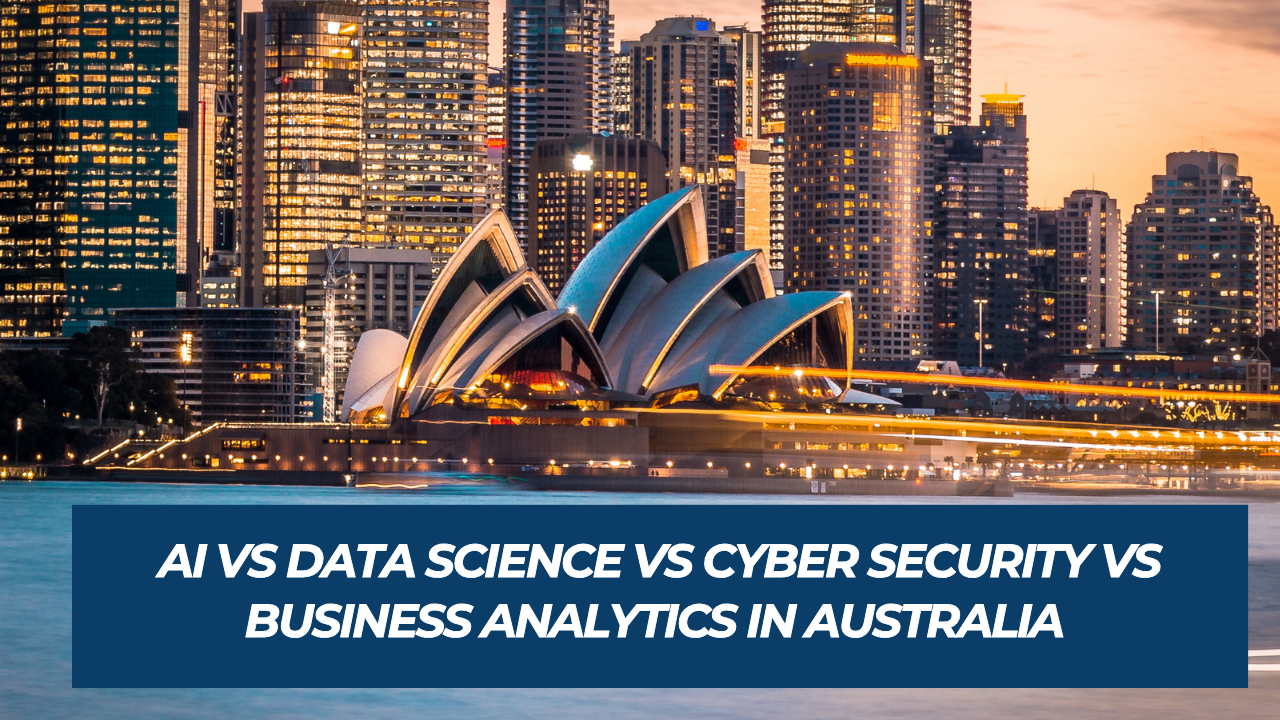
One of the most common mistakes students make today is choosing a course based on trends rather than understanding. Many students are confused between Artificial Intelligence (AI), Data Science, Cyber Security, and Business Analytics.
These fields are often grouped together as “tech courses,” but in reality, they are fundamentally different in terms of skills, applications, and career paths. Choosing the wrong one can lead to academic difficulties and limited career growth.
Why This Confusion Exists
1. All Fields Involve Data and Technology
All four domains involve working with data and technology and are closely connected to digital transformation. However, they solve entirely different types of problems.
2. University Course Structures Overlap
At universities such as University of Technology Sydney, Macquarie University, and La Trobe University, courses may have overlapping subjects, similar names, or shared modules. This often increases confusion among students.
Understanding Each Field
Artificial Intelligence (AI)
Artificial Intelligence focuses on building systems that can simulate human intelligence and learn from data.
Core areas include machine learning, deep learning, and neural networks.
Typical applications include chatbots, recommendation engines, and autonomous systems.
Data Science
Data Science is about extracting insights from structured and unstructured data.
It involves data cleaning, statistical analysis, and predictive modelling.
Common applications include sales forecasting and customer behavior analysis.
Cyber Security
Cyber Security focuses on protecting systems, networks, and data from digital threats.
It includes network security, ethical hacking, and risk management.
Typical use cases involve preventing cyberattacks and securing sensitive data.
Business Analytics
Business Analytics focuses on using data to make informed business decisions.
It includes reporting, dashboard creation, and performance analysis.
Applications include marketing optimization and financial decision-making.
Core Differences
| Factor | AI | Data Science | Cyber Security | Business Analytics |
|---|---|---|---|---|
| Complexity | Very High | High | Medium–High | Moderate |
| Coding | Heavy | Heavy | Medium–High | Moderate |
| Maths | Very High | High | Medium | Medium |
| Focus | Automation | Data Insights | Security | Business Decisions |
| Difficulty | Highest | High | Medium | Moderate |
This comparison clarifies most of the confusion students face.
Skills Required
AI
Requires strong mathematical foundations, programming (especially Python), and algorithmic thinking.
Data Science
Requires knowledge of statistics, programming, and data manipulation tools.
Cyber Security
Requires understanding of networking, security tools, and system architecture.
Business Analytics
Requires proficiency in Excel, SQL, visualization tools, and business understanding.
Each field demands a distinct skill set, and alignment with your strengths is critical.
Career Outcomes in Australia
AI Careers
Roles include AI Engineer and Machine Learning Engineer
Salary range: AUD 100,000 to 150,000+
Data Science Careers
Roles include Data Scientist and Data Analyst
Salary range: AUD 80,000 to 130,000
Cyber Security Careers
Roles include Security Analyst and Cyber Consultant
Salary range: AUD 85,000 to 140,000
Business Analytics Careers
Roles include Business Analyst and Reporting Analyst
Salary range: AUD 70,000 to 110,000
All four fields offer strong opportunities, but entry requirements and difficulty levels vary.
Difficulty Level: Reality Check
Artificial Intelligence is the most demanding field and requires strong expertise in both mathematics and programming.
Data Science is also highly technical and requires consistent practice.
Cyber Security is technical but less focused on mathematics.
Business Analytics is relatively more accessible and suitable for students from non-technical backgrounds.
The key takeaway is that difficulty does not determine success. The right fit does.
How to Choose the Right Course
Step 1: Assess Your Background
| Background | Recommended Field |
|---|---|
| IT / Engineering | AI or Data Science |
| Commerce | Business Analytics |
| Mixed | Cyber Security or Analytics |
Step 2: Identify Your Strengths
| Strength | Best Fit |
|---|---|
| Maths and Coding | AI |
| Data and Logic | Data Science |
| Systems and Security | Cyber Security |
| Business Thinking | Business Analytics |
Step 3: Define Your Career Goal
| Goal | Course |
|---|---|
| Build intelligent systems | AI |
| Analyze and interpret data | Data Science |
| Protect systems and networks | Cyber Security |
| Solve business problems | Business Analytics |
Common Mistakes Students Make
- Choosing AI without a strong mathematical background
- Selecting Data Science without coding skills
- Opting for Cyber Security without IT fundamentals
- Assuming Business Analytics is easy without understanding tools
- Following trends instead of making informed decisions
University Positioning
University of Technology Sydney
Known for strong industry-oriented programs in Data Science and Business Analytics.
Macquarie University
Offers flexible pathways and combinations of Analytics and AI.
La Trobe University
Recognized for career-focused programs in AI and Cyber Security.
ROI Comparison
| Course | ROI Speed | Risk Level |
|---|---|---|
| AI | Medium | High |
| Data Science | Medium | Medium |
| Cyber Security | Medium–Fast | Medium |
| Business Analytics | Fast | Low |
Business Analytics offers quicker returns with lower risk, while AI provides higher long-term rewards but with greater challenges.
Future Outlook (2026–2030)
All four fields are expected to grow due to increasing data generation, automation, rising cyber threats, and the need for data-driven decision-making. However, job roles and required skills will continue evolving.
Final Insight
There is no universally “best” course. There is no guaranteed job. There is no shortcut to success.
The right decision depends on your background, skills, and career goals. Making an informed choice is critical to maximizing your return on investment in education.