In recent years, student decision-making has evolved significantly.
Today, the question is no longer:
- “Which course is best?”
Instead, students are asking:
- “Which course gives me maximum flexibility and long-term career options?”
This shift reflects a deeper reality:
- Many students are uncertain between Data Science, AI, and Business roles
- Academic backgrounds are increasingly diverse
- Career paths are no longer linear
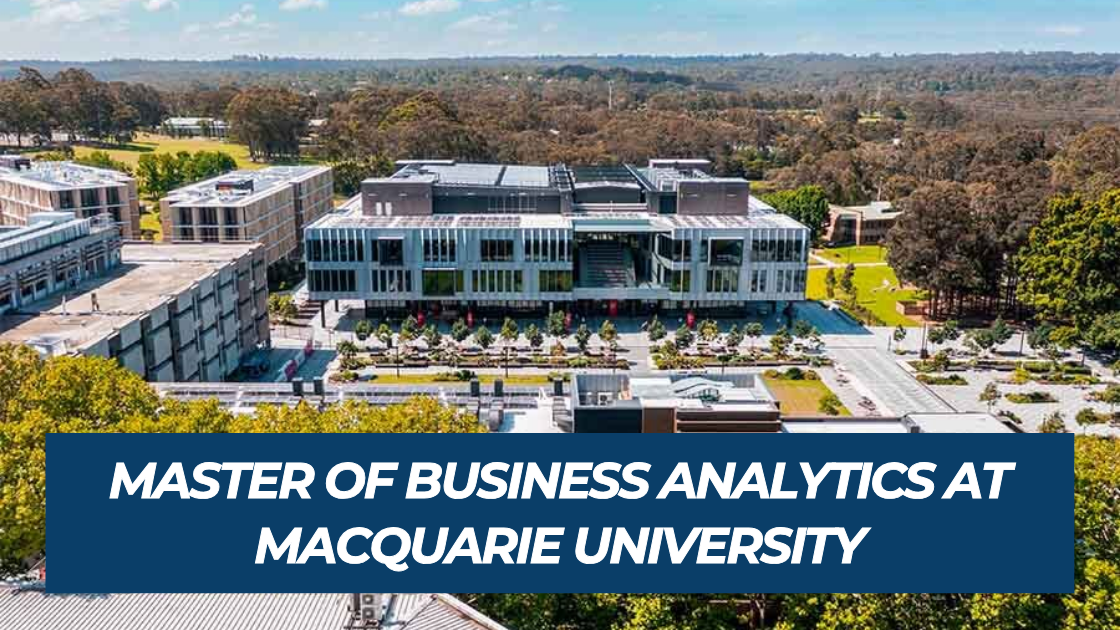
In this context, the Master of Business Analytics at Macquarie University emerges not just as a degree—but as a strategic entry point into the data-driven economy.
What Business Analytics Really Means at Macquarie
Business Analytics is often misunderstood as limited to dashboards or Excel work. At Macquarie, it is positioned more strategically.
Core Objective:
Using data to:
- Solve real-world business problems
- Improve decision-making
- Drive measurable outcomes
Program Components:
1. Data Interpretation
- Trend analysis
- Insight extraction
2. Technical Tools
- SQL
- Data visualization platforms
- Analytics software
3. Business Application
- Marketing analytics
- Operations strategy
- Financial decision-making
4. Decision Frameworks
- Translating insights into actionable strategies
This combination of technical + business + strategic thinking is what drives employability.
Why Choose Macquarie University?
1. Strategic Location Advantage (Macquarie Park)
Macquarie University is located in Macquarie Park, one of Australia’s largest business and technology hubs.
Key highlights:
- 300+ global companies nearby
- Strong presence of finance, tech, and consulting firms
This directly translates into:
- Internship opportunities
- Industry exposure
- Networking advantages
2. Course Flexibility (Core Strength)
Unlike rigid programs, Macquarie offers:
- Electives
- Specialization pathways
- Integration across AI, Data, and Business
This is crucial because:
- Students often discover their strengths during the course
- Career interests evolve over time
Macquarie supports adaptability—not restriction
3. Strong Academic Ecosystem
Macquarie is known for excellence in:
- Business
- Data Science
- Artificial Intelligence
- Finance
This enables:
- Cross-disciplinary learning
- Skill expansion beyond a single domain
Course Structure: Layered and Practical
The program is designed to balance accessibility with depth.
Foundation Layer
- Statistics basics
- Data handling
- Business fundamentals
Core Analytics Skills
- Data analysis techniques
- SQL & databases
- Data visualization
Applied Analytics
- Marketing analytics
- Financial analytics
- Operations analytics
Advanced / Electives
- Machine learning basics
- Predictive analytics
- Strategy & consulting
Result: Suitable for both beginners and serious learners.
Who Should Choose This Course?
Ideal Candidates:
- Commerce / BBA graduates
- Engineers moving toward business roles
- Students confused between Data Science and business
- Individuals seeking flexibility
Not Ideal For:
- Students wanting hardcore programming
- Those avoiding technical learning entirely
- Purely theoretical learners
Comparison with Other Universities
Macquarie vs University of Technology Sydney
| Factor | Macquarie | UTS |
|---|---|---|
| Structure | Flexible | More structured |
| Learning Style | Balanced | Highly applied |
| Best For | Exploration | Clear career direction |
Insight:
- UTS suits students with defined goals
- Macquarie suits those in exploration mode
Macquarie vs La Trobe University
| Factor | Macquarie | La Trobe |
|---|---|---|
| Location | Sydney | Melbourne |
| Flexibility | High | Moderate |
| Focus | Broad | Career-focused |
Career Outcomes After Graduation
Common Roles:
- Business Analyst
- Data Analyst
- Reporting Analyst
- Strategy Analyst
- Product Analyst
Career Growth Path:
- 0–2 years: Analyst
- 3–5 years: Senior Analyst
- 5+ years: Manager / Consultant
Industry Demand
Analytics roles are present across:
- Banking
- Consulting
- Retail
- Government
- Technology
- Logistics
This ensures career mobility and industry flexibility
Salary Benchmarks in Australia
| Level | Salary Range |
|---|---|
| Entry-Level | AUD 70K – 90K |
| Mid-Level | AUD 90K – 120K |
| Senior Roles | AUD 120K – 150K+ |
Compared to traditional roles:
- Faster growth
- Higher demand
- Strong earning potential
ROI (Return on Investment)
Tuition Estimate:
- AUD 40,000 – 50,000
Break-even Timeline:
- Typically 2–3 years (based on AUD 80K–100K salary)
Key ROI Drivers:
- Internships
- Skill development
- Networking
- Location advantage
The Core Advantage: Flexibility vs Specialisation
This is the most critical distinction.
Macquarie offers:
- Flexibility
- Broad exposure
- Exploration
Other universities offer:
- Specialisation
- Structured pathways
Insight:
Macquarie is ideal for students who:
- Are unsure about their exact career path
- Want exposure before committing
- Prefer adaptable learning environments
Common Mistakes Students Make
- Choosing analytics without genuine interest in data
- Ignoring flexibility benefits
- Comparing only university rankings
- Not reviewing course structure
- Expecting jobs without building skills
Why Indian Students Prefer Macquarie
Many Indian students:
- Come from commerce backgrounds
- Are undecided between tech and business
- Seek a safe yet flexible option
Macquarie delivers:
- Balanced curriculum
- Multiple career pathways
- Strong industry exposure
Future Outlook
Business Analytics will continue to grow because:
- Data-driven decision-making is expanding
- Businesses rely on insights
- AI still requires human interpretation
Analytics professionals will remain indispensable.
Conclusion
The Master of Business Analytics at Macquarie University is not just a course—it is a career strategy.
It enables you to:
- Enter the data-driven economy
- Build adaptable skills
- Keep multiple career pathways open
The real question is:
Is it the right fit for you?
Final Recommendation
If you are:
- Confused between UTS and Macquarie
- Unsure between Data Science and Analytics
- Planning for the 2026 intake
A structured, profile-based approach is essential.
Educircle helps you with:
- Course matching based on your background
- University comparison
- Long-term career planning