A City in Transition
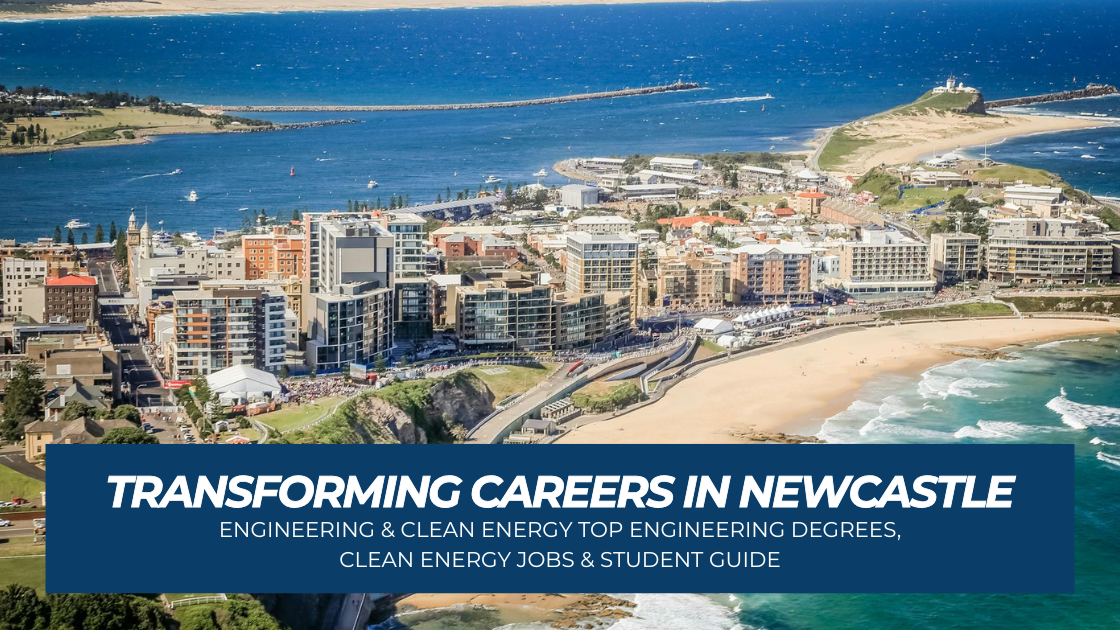
Newcastle doesn’t sell itself the way Sydney or Melbourne does. There are no glossy postcards of skylines or trendy laneways. What Newcastle has instead is something more interesting for the right kind of student — a real, working industrial economy that is actively transforming itself.
For over a century, Newcastle was Australia’s coal capital. The Hunter Valley supplied much of the nation’s energy. Ships loaded with coal left from what remains one of the busiest ports on Australia’s east coast. And then, piece by piece, the old economy started to shift. The steelworks shut down in 1999. Manufacturing employment has been declining. The coal story isn’t over — Newcastle is still one of the world’s largest coal export harbours — but the direction is clear. The city’s future is being written in clean energy, hydrogen, advanced engineering, healthcare, and construction.
That transition is what makes Newcastle uniquely relevant for international students right now. You’re not arriving into a finished economy. You’re arriving into one that’s being rebuilt — and that creates a very different kind of opportunity.
The Economic Picture
Newcastle’s Gross Regional Product sits at around $22.7 billion, which accounts for nearly 3% of the entire New South Wales economy. That’s not a small regional town number. That’s a proper city-scale economy — the second largest in the state after Sydney.
Construction is Newcastle’s single biggest industry by output, generating close to $5.8 billion in 2023/24. Healthcare and social assistance is disproportionately large here compared to the state average — nearly 10% of Newcastle’s output comes from health, versus about 6% for NSW overall. Electricity, gas, water and waste services are also overrepresented, sitting at almost 6% of the city’s output compared to 3% at the state level.
What this tells you is that Newcastle’s economy leans toward things that get built, things that get generated, and things that keep people well. It’s not a finance town or a media town. It’s an engineering and services town. If your interests lie in those directions, Newcastle’s economy will actually make sense to you.
The Clean Energy Shift — And Why It Matters for Students
Here is where Newcastle gets genuinely interesting from a career perspective.
The Hunter Valley, with Newcastle at its centre, is being positioned as a national hub for green hydrogen production. The NSW Government has poured significant money into this — a $70 million hydrogen hub initiative, plus $100 million from the federal government to make the Port of Newcastle hydrogen-ready. In mid-2025, ARENA allocated $432 million to progress the Hunter Valley Hydrogen Hub, a 50-megawatt electrolyser project on Kooragang Island developed by Origin Energy in collaboration with Orica. That project alone received planning approval and is expected to produce around 4,700 tonnes of renewable hydrogen per year.
The Port of Newcastle is also developing a Clean Energy Precinct — a dedicated zone for renewable energy infrastructure. According to current estimates, this precinct could generate approximately 5,800 new jobs in the Hunter region by 2040.
These are not entry-level hospitality jobs. These are engineering, logistics, environmental management, and technical operations roles. They require specific skills — and specific qualifications. For a student thinking ahead, studying in Newcastle and being physically close to these projects during your degree gives you something that studying the same subject in a capital city doesn’t — proximity to the industry as it forms.
The University Connection
The University of Newcastle is ranked second in Australia and 18th in the world for Automation and Control Engineering. It also ranks in the global top 200 for Civil and Structural Engineering. The university was built alongside the Hunter Valley’s industrial economy, and its engineering faculty has deep roots in mining, energy, and heavy industry.
Beyond engineering, the university offers strong programs in health and medicine (including a Joint Medical Program), environmental science, business, IT, and education. It hosts over 5,000 international students from more than 120 countries, and offers a 20% international tuition fee waiver for high-performing students.
Courses That Fit Newcastle
Engineering is the standout — civil, mechanical, chemical, electrical, environmental, and mechatronics engineering all have direct relevance to what’s happening here. The university offers combined degrees like Mechanical Engineering with Business that give both technical depth and commercial understanding.
Health and medicine make strong sense. Newcastle’s health sector is larger than the state average, and the regional health system provides placement opportunities that are sometimes easier to access than in oversaturated capital city hospitals.
Environmental science and sustainability studies are increasingly relevant given the clean energy focus. IT and computer science work well when combined with engineering or business, as demand grows for technical skills in energy monitoring, logistics systems, and automation.
The Honest Trade-offs
Newcastle’s international student community is smaller than in the capital cities, so the social infrastructure — ethnic grocery stores, cultural events, community groups — is more limited. Public transport exists but isn’t as comprehensive as in Sydney. The city also has a lower proportion of people born overseas — about 14.5% compared to 34% for NSW overall. Some students find this refreshing. Others find it isolating.
A well-budgeted student can expect monthly living costs of around AUD $1,700 to $1,900 including rent — significantly less than Sydney. When you combine lower tuition with lower living costs, the total cost of a Newcastle degree can be substantially less than an equivalent qualification in a capital city.
Who Should Choose Newcastle
Students who know they want to work in engineering, clean energy, construction, health, or environmental science. Students who want to be physically close to real industry — not in an abstract sense, but near projects, sites, and employers. Students who value affordability and prefer a smaller, more personal university experience.
Newcastle is probably not the right choice for students who want a generic business degree, who are mainly interested in finance or media, or who need a large, diverse international community to feel comfortable.
The Verdict
Newcastle is a city that has already reinvented itself once, and it’s doing it again. The coal economy didn’t disappear overnight, and the clean energy economy won’t appear overnight either. But the direction is clear, the investment is flowing, and the university is deeply connected to what’s happening. For the right student — technically minded, career-focused, comfortable with a mid-sized city — Newcastle offers the chance to study at the centre of an industry being built from the ground up.
Want help figuring out if this city is the right fit for your goals? Talk to the Educircle team.